
Safe and Fast Radial Artery Hemostasis Using Synergistic Strategies: SAFE and FASTTrial

Safe and Fast Radial Artery Hemostasis Using Synergistic Strategies: SAFE and FASTTrial
Khyati Khattar, MDa, Anurag Barot, MD, DNBb, Aman T. Patel, MD, DMb, Sunil V. Rao, MDc, Chi-Hong Tseng, PhDd, Nishant Sethi, MDa, Tejas Patel, MD, DMb, Rajendra Sardesai, MBA, JD, PhDa, Samir B. Pancholy, MDa*
- The Wright Center for Graduate Medical Education, Scranton, Pennsylvania
- Apex Heart Institute, Ahmedabad, India
- NewYork University Grossman School of Medicine, New York, NY d Di
- Division of General Internal Medicine and Health Services Research, University of California at Los Angeles, Los Angeles, California
ARTICLE INFO
Article History:
Received 14 May 2026
Revised 13 August 2026
Accepted 14 August 2026
Keywords:
transradial
hemostasis
efficacy
safety
Transradial access (TRA) has been increasingly utilized for cardiac catheterization. Pursuit of faster patient throughput has generated a need for more rapid hemostasis protocols that are safe, effective, and affordable. Patients undergoing diagnostic cardiac catheterization using TRA at 2 tertiary-care centers were randomized to receive the standard of care procedure utilizing 5/6 French hydrophilic introducer sheath, with 50 units/kg of heparin during the procedure and a 2-hour hemostatic compression using a single-balloon device (Group 1), or 25 units/kg of heparin, with 1-hour hemostatic compression using a dual-balloon device capable of simultaneous ipsilateral ulnar artery compression (Group 2). The primary study endpoint was a composite of radial artery occlusion, rebound bleeding, or hematoma formation. A total of 451 patients were randomized: 224 in Group 1 and 227 in Group 2. A significant reduction in the primary endpoint was observed in Group 2 as compared with Group 1 (4% vs 10.3%, p = 0.01). Patent hemostasis was achieved in 97% of patients in Group 2, compared with 81% in Group 1 (p = 0.001), with fewer nursing visits in Group 2 (5.3 § 0.8 vs 3.1 § 0.3, p = 0.001). Group 2 patients also achieved successful hemostasis with a significant reduction in duration of compression (mean reduction = 62 minutes, p = 0.001). In conclusion, a strategy of using a lower dose of heparin with ulnar artery compression achieves shorter duration hemostasis after TRA with significantly less rebound bleeding and radial artery occlusion, as compared with the conventional strategy
Published by Elsevier Inc
Transradial access (TRA) has been shown to improve clinical outcomes,1 patient comfort,2 and reduce costs,3 across a wide spectrum of diagnostic and interventional cardiovascular procedures.
Radial artery occlusion (RAO), an important complication of TRA, remains consistently prevalent in real-world analyses.4 Shorter durations of hemostatic compression are associated with a decrease in the incidence of RAO and an increase in patient throughput, but it is also associated with an increase in rebound bleeding, with a resultant decrease in hemostatic efficacy.5,6 Residual heparin effect is likely one of the reasons for these rebound bleeding events.7 Local procoagulant patch-based strategies have shown encouraging results.8 In this trial, not adequately powered for the RAO and bleeding outcomes, the patch-based strategy with shorter compression time did not significantly improve these outcomes.8 Lowering the dose of heparin below 50 units/kg has been shown to increase the risk of RAO.9,10
We sought to compare a strategy of shorter compression time, using a lower dose of heparin in conjunction with simultaneous ipsilateral ulnar artery compression (UC), with the current standard of care procedural strategy in patients undergoing diagnostic transradial cardiac catheterization.
Patients and Methods
Patients presenting for diagnostic transradial cardiac catheterization at 2 tertiary-care centers were approached for enrollment. The study protocol was approved by local institutional review boards at both participating centers. The study was registered on ClinicalTrials.
gov (NCT06549842).
Inclusion and exclusion criteria are listed in Supplemental Table 1.
Primary endpoint
The primary study endpoint was a composite of RAO evaluated after the removal of the compression device, occurrence of rebound bleeding necessitating reapplication of hemostatic compression, or hematoma formation during or after the procedure, ranked by EASY criteria.11
Secondary endpoints
The secondary study endpoints were the number of nursing visits after the procedure and before discharge from the cardiac catheterization laboratory, and total duration of hemostatic compression. Nursing visits included the number of times the nurse entered the patient’s room to assess/treat the patient and charted the visit.
Randomization
Using the SNOSE method,12 after informed consent was signed in the preop holding room before catheterization, the patients were randomized to either Group 1 or Group 2.
Group 1: These patients received the standard of care transradial procedure using best practices as described by professional society guidelines.13 A 5/6 hydrophilic slender introducer (Terumo Interventional Systems, Tokyo, Japan) was inserted in the radial artery after percutaneous puncture. All patients in this group received a vasodilator cocktail consisting of 200 mg of nitroglycerin and 2.5 mg of verapamil administered intra-arterially through the introducer sheath, and 50 units/kg body weight of unfractionated heparin administered intravenously as a bolus after obtaining guidewire access to the ascending aorta. The diagnostic cardiac catheterization procedure was performed using equipment and protocols as per operator discretion. There were no cases of failed guidewire access to the ascending aorta, and no patients had femoral bailout. Although discouraged, ad-hoc percutaneous coronary intervention (Fractional flow esearve/percutaneous coronary intervention) occurred in 1 patient. Acute coronary syndrome patients were excluded because they were on
preprocedural Heparin/Enoxaparin
After conclusion of the procedure, patients in this group received a single-balloon hemostasis band (TR band; Terumo Interventional Systems) applied at the puncture site for 2 hours, using patent hemostasis protocol described earlier.14 The volume of air in the balloon was recorded. Patency was evaluated during hemostasis using plethysmography. Postprocedural staff, including nurses and technologists, evaluated the access site and radial artery patency during hemostasis at least every 30 minutes and more often if the plethysmography suggested RAO. If no radial flow was detected, then the radial balloon pressure was deflated by the least amount of volume to reestablish flow (nursing protocol). After 1 hour of compression with patent hemostasis, the radial artery compression balloon was gradually deflated over the next 60 minutes by removing 1/3 of the recorded volume of air every 20 to 30 minutes, and at 2 hours, the band was removed. If there was bleeding, the radial balloon was inflated with additional air using the least amount of volume to reestablish hemostasis. Upon removal of the band, the patient was observed for at least the next 30 minutes, and if dry hemostasis was persistently observed, radial artery patency was evaluated with ultrasound. If any bleeding occurred at the access site, the band was reapplied for 20 minutes maintaining patent hemostasis and then weaned off over the next 10 minutes. Once dry hemostasis was achieved, radial artery patency was evaluated using ultrasound. Subsequently, a light dressing was applied at the access site, and the patient was discharged or transferred to their inpatient unit.
Group 2: These patients underwent a similar procedure as mentioned above except for the following differences: after obtaining TRA with a 5/6 hydrophilic introducer sheath, the same vasodilator cocktail was administered intra-arterially, and after guidewire placement in the ascending aorta, 25 mg/kg body weight heparin was administered intravenously as a bolus. After completion of the procedure, these patients received a dual-bladder hemostasis band (VASOBand; VASOinnovations Inc., South Pasadena, California) (Figure 1), with ipsilateral ulnar compression provided by the ulnar balloon inflated with 15 ml of air. Radial artery puncture site compression was provided by the radial balloon, inflated using patent hemostasis protocol, whereby the least necessary pressure to obtain dry hemostasis was applied, and the volume of air in the radial balloon was recorded.
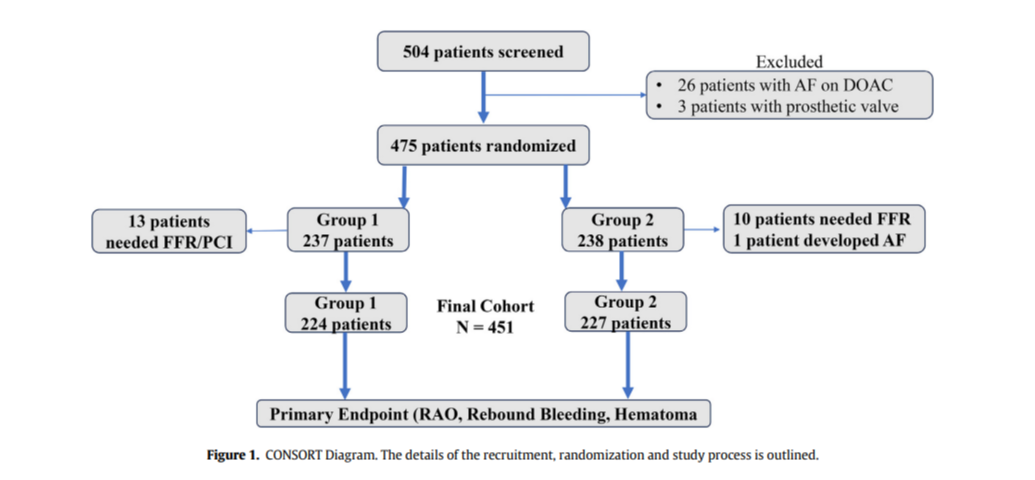
Patent hemostasis was evaluated upon patients’ arrival in the recovery unit in a standard fashion.14 Any loss of pulsatile signal during evaluation by nurses during hemostatic compression in Group 1 or during continuous monitoring of plethysmographic signal in Group 2 was considered absence of patent hemostasis.
Hand or forearm pain during compression, the number of nursing visits before discharge after onset of hemostatic compression, any bleeding after removal of the hemostatic compression band, and occurrence of a hematoma at the access site or in the forearm were recorded. Nursing visits were defined as the number of times the nurse entered the patient’s room to assess/treat the patient and charted the visit. Any bleeding was defined as lack of dry hemostasis with continuous extravasation of blood necessitating intervention (compression). Applying pressure bandage was not allowed. It was evaluated and treated by nursing staff trained in post-TRA hemostasis.
Radial artery patency prior to discharge was evaluated using ultrasound for all patients. RAO was defined as absence of antegrade flow in the instrumented radial artery distal to the puncture site.
Statistical Analysis
Sample size calculation
The sample size for this study was calculated based on the composite primary endpoint. Based on published contemporary data,10,18 we expected a primary composite endpoint incidence of 8.2% in Group 1. We expected a primary endpoint incidence of 4.5% for Group 2 based on a pilot study of 50 patients using the VASOBand delivering hemostatic compression for 1 hour and a dose of 25 units/kg Heparin and also based on findings with 1 hour compression in a similar dataset of 443 patients.8 A superiority trial was not feasible given the available resources; therefore, we undertook 2 strategies for sample size calculation and efficacy assessment of VASOBand. First, we calculated the sample size using a noninferiority margin of 3%, effectively declaring noninferiority if the rate of the primary outcome ≤3% higher in the VASOBand group than in the control group. Using normal approximation and conventional statistical methodology, the required sample size was assessed at 207 subjects per group, that is, a total of 414 patients. To account for potential dropouts, ineligible subjects, or loss to follow-up, we planned to enroll a total study patient sample of 450 patients. Second, if noninferiority was met, then we prespecified testing for superiority of VASOBand.
Summary statistics were calculated for demographic and procedural variables by randomization group to characterize the study population. Proportions for the composite primary endpoint, its individual components, and secondary endpoints were reported for each group. The 95% confidence intervals (CIs) for the primary endpoint within each group and the difference between groups were constructed using the normal approximation to the binomial distribution. Noninferiority was established if the upper bound of the 2-sided 95% CI for the difference in proportions did not exceed the prespecified oninferiority margin. If noninferiority was met, superiority was subsequently evaluated using a chi-square test for the primary endpoint and its components.
Independent predictors of the composite primary endpoint were identified using binary logistic regression, with the primary endpoint as the dependent variable, and univariate analyses identified variables significantly associated with the primary outcome. Hosmer −Lemeshow test was performed to evaluate goodness-of-fit and the area under the receiver-operator characteristic curve was measured to evaluate the discriminative ability of the multivariable model. Sample size calculation and all analyses were performed using R(www.r-project.org).
Results
Patent hemostasis was evaluated upon patients’ arrival in the recovery unit in a standard fashion.14 Any loss of pulsatile signal during evaluation by nurses during hemostatic compression in Group 1 or during continuous monitoring of plethysmographic signal in Group 2 was considered absence of patent hemostasis.
Hand or forearm pain during compression, the number of nursing visits before discharge after onset of hemostatic compression, any bleeding after removal of the hemostatic compression band, and occurrence of a hematoma at the access site or in the forearm were recorded. Nursing visits were defined as the number of times the nurse entered the patient’s room to assess/treat the patient and charted the visit. Any bleeding was defined as lack of dry hemostasis with continuous extravasation of blood necessitating intervention (compression). Applying pressure bandage was not allowed. It was evaluated and treated by nursing staff trained in post-TRA hemostasis.
Radial artery patency prior to discharge was evaluated using ultrasound for all patients. RAO was defined as absence of antegrade flow in the instrumented radial artery distal to the puncture site.
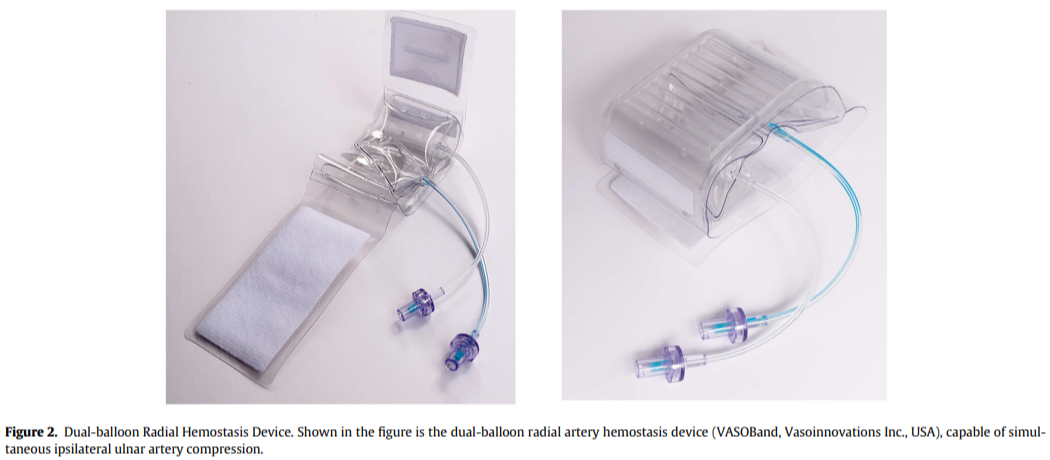
Table 1
Baseline characteristics
| Group 1 (N = 224) | Group 2 (N = 227) | p Value | |
|---|---|---|---|
| Age (years) | 62 (50 to 72) | 59 (48 to 68) | 0.04 |
| Female, n (%) | 81 (36) | 73 (32) | 0.37 |
| Hypertension, n (%) | 120 (54) | 110 (49) | 0.30 |
| Diabetes, n (%) | 81 (36) | 67 (29) | 0.16 |
| Active smoker, n (%) | 46 (21) | 54 (24) | 0.43 |
| History of PCI, n (%) | 17 (8) | 25 (11) | 0.26 |
| History of CABG, n (%) | 15 (7) | 22 (10) | 0.30 |
| Height (cm)* | 168 (160 to 173) | 168 (161 to 172) | 0.41 |
| Weight (kg)* | 77 (67 to 84) | 75 (68 to 86) | 0.95 |
| Hemoglobin (g/dl)* | 12.9 (11.8 to 14.2) | 13.2 (11.6 to 14.5) | 0.12 |
| WBC count* | 7,660 (6,200 to 8,800) | 7,530 (6,170 to 8,700) | 0.93 |
| Platelet count (≤1,000/dl)* | 260 (200 to 322) | 265 (200 to 322) | 0.95 |
| Blood urea nitrogen (mg/dl)* | 25 (20 to 32) | 26 (18 to 31) | 0.42 |
| Creatinine (mg/dl)* | 0.9 (0.8 to 1.1) | 0.9 (0.8 to 1.09) | 0.89 |
| P2Y12 inhibitor use, n (%) | 47 (21) | 45 (20) | 0.81 |
CABG = coronary artery bypass graft surgery; PCI = percutaneous coronary intervention; WBC = white blood cell count. * Median (interquartile range).
Table 2
Procedure characteristics
| Group 1 (N = 224) | Group 2 (N = 227) | p Value | |
|---|---|---|---|
| Barbeau test pattern (%) | 0.76 | ||
| A | 95 | 96 | |
| B | 2.7 | 2.6 | |
| C | 2.2 | 1.3 | |
| Sedation (%) | 30 | 26 | 0.46 |
| Air kerma (milligray) | 290 (232 to 451) | 291 (233 to 437) | 0.92 |
| Fluoroscopy time (minutes) | 3 (2.4 to 4.7) | 3 (2.3 to 4.5) | 0.15 |
| Number of catheters | 1 (1 to 1) | 1 (1 to 1) | 0.64 |
| Procedure duration (minutes) | 10 (10 to 16) | 10 (10 to 15) | 0.15 |
| Arm pain (%) | 12 | 6 | 0.03 |
| Patent hemostasis (%) | 81 | 97 | 0.001 |
A significant reduction in the number of necessary monitoring nurse visits to evaluate the patient during hemostasis was noted in Group 2 compared to Group 1, with a mean reduction of 2 nurse visits in Group 2 (Group 1 = 5.3 § 0.8 vs Group 2 = 3.1 + 0.3, p = 0.001). With VASOBand, the plethysmographic signal on the monitor screen provided continuous display of radial patency (or lack thereof) eliminating the need for nurse evaluation with manually performed reverse Barbeau test.
Primary and secondary outcomes
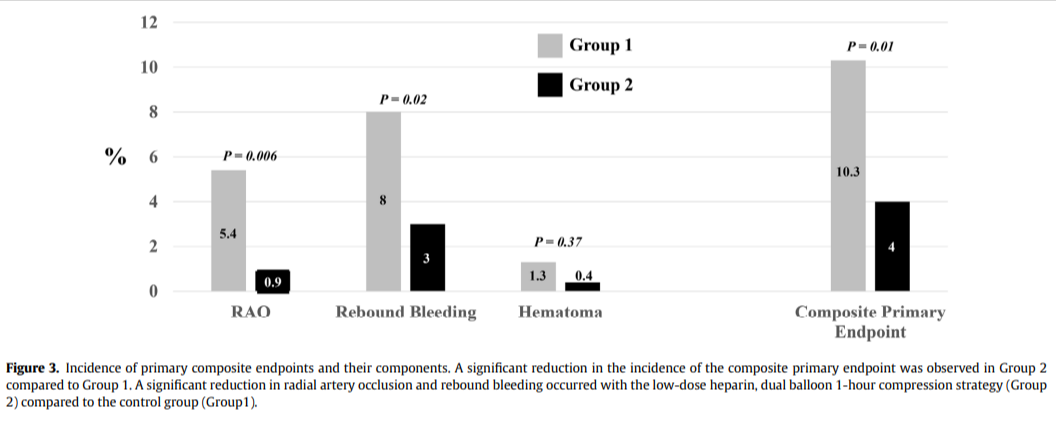
The findings of the composite primary endpoint, its individual components and secondary endpoints are outlined in Table 3 and
Table 3
Procedure characteristics
| Group 1 (N = 224) | Group 2 (N = 227) | p Value | |
|---|---|---|---|
| Primary outcome (composite), n (%) | 23 (10.3) | 9 (4) | 0.01 |
| Radial artery occlusion | 12 (5.4) | 2 (0.9) | 0.006 |
| Rebound bleeding | 18 (8) | 7 (3) | 0.02 |
| Hematoma | 3 (1.3) | 1 (0.4) | 0.37 |
| Secondary outcomes | |||
| Total compression time (minutes)* | 123 ± 9 | 61 ± 4 | 0.001 |
| Total nurse visits* | 5.3 ± 0.8 | 3.1 ± 0.3 | 0.001 |
Figure 3. The primary endpoint was observed significantly less frequently in Group 2 compared to Group 1 (Group 1 = 10.3%, 95% CI 6.3% to 14.2% vs Group 2 = 4%, 95% CI 1.4% to 6.4%, p = 0.01). The estimated treatment difference was 6.3% (95% CI 1.6% to 11%). Comparing the 95% CI and the prespecified noninferiority margin of 3%, the null hypothesis was rejected at the 5% level, establishing the noninferiority of VASOBand. Subsequent superiority testing confirmed that Group 2 had a significantly lower incidence of the primary endpoint compared to Group 1 (p = 0.01). This difference was predominantly driven by a significant reduction in occurrence of rebound bleeding and RAO in Group 2 compared to Group 1. Hematomas were observed in 0.9% of patients; all of them were EASY Grade I and II. Although numerically Group 2 had a lower incidence of hematomas compared to Group 1, the difference in the occurrence of hematomas between the 2 groups was not statistically significant (1.4% in Group 1 and 0.4% in Group 2, p = 0.37).
Other outcomes
In our study cohort, no evidence of thrombus in the lumen or the outer body of the diagnostic angiographic catheter was observed. Four percent of patients in Group 1 and 3.5% of patients in Group 2 had evidence of thrombus upon purging the introducer sheath after catheter withdrawal. The difference between the groups was statistically nonsignificant (p = 0.81). No embolic events occurred.
Adjusted analysis
Body weight (odds ratio [OR] = 0.97, 95% CI 0.94 to 1, p = 0.03), diabetes mellitus (OR = 2.1, 95% CI 1.1 to 4.3, p = 0.04) and randomization to Group 2 (OR = 0.34, 95% CI 0.15 to 0.75, p = 0.01) were identified as the independent predictors of the composite outcome of RAO, rebound bleeding or hematoma. Upon entering patent hemostasis as an independent variable in the multivariable model, randomization to Group 2 lost its significance (OR = 0.9, 95% CI 0.35 to 2.3, p = 0.8), suggesting a mediation of Group 2 advantage by its positive effect on patent hemostasis (OR = 0.04, 95% CI 0.01 to 0.09, p < 0.001). Both models showed excellent discriminative ability (cstatistic = 0.71 and 0.83, respectively) and goodness of fit (Hosmer −Lemeshow test p = 0.39 and 0.21, respectively).
Adverse events
No major adverse cardiac events occurred at 24 hours in either group. One patient in Group 1 developed a pseudoaneurysm 8 days after the procedure, which was successfully treated with thrombin injection.
Discussion
The results of our randomized controlled trial show that a faster radial artery hemostasis protocol (60 minutes) using a lower dose of heparin (25 units/kg) combined with UC is superior to the conventional hemostasis protocol (120 minutes) in patients undergoing transradial diagnostic cardiac catheterization. The duration of hemostatic compression can be safely and significantly decreased by approximately 1 hour, with superior key safety outcomes including reduced incidence of RAO and rebound bleeding, without utilizing any adjunctive devices.
When fastidiously practiced, traditional patent hemostasis protocol has been shown to improve the rates of RAO. In large, randomized controlled trials, it has led to achievement of low rates of RAO.15 Conflicting with these observations from randomized trials are the realworld datasets that continue to report a significantly higher and concerning incidence of RAO.4 This discrepancy is likely driven by the conscious effort on the part of the catheterization laboratory team in enforcing patent hemostasis in a randomized trial setting, with results likely driven by a “Hawthorne effect.” 16 In a real-world setting, as shown earlier, likely due to the pressures of procedural volume as well as lack of ability to train or obtain “buy in” from the postprocedural unit staff, enforcement and achievement of patent hemostasis has been challenging.17 The strategy of simultaneous ipsilateral UC during radial artery hemostasis has been shown to maximize the probability of patent hemostasis by favorably altering local arterial hemodynamics, increasing radial artery flow18 without the need for frequent monitoring or nuanced adjustment of compression pressure by staff.19
Our results reproduced the observations of near universal (97%) achievement of patent hemostasis with the dual-compression strategy, which was significantly better than the control group, despite the fact that the staff at both study centers were well versed with the practice of patent hemostasis protocol in the control group. This was achieved with a significant reduction in the need for nursing observation compared to the conventional strategy. This “democratization” of patent hemostasis by using UC ensures less dependence on human factors, including staff training, turnover, and abilities, maximizing
protection from RAO. Also, the reduction in the composite primary endpoint was likely driven by the mediator variable of patent emostasis, as evidenced by the loss of significance of randomization to Group 2 upon entering patent hemostasis as an independent variable
in the multivariable model.
Shorter emostatic compression duration, besides being desirable from a standpoint of throughput, has also been shown to lower the risk of RAO. With standard dose heparin use, rebound bleeding has been shown to be a persistent deterrent when using <2 hours hemostatic compression time.5,9 Not only does this decrease the patient’s and care team’s confidence in the hemostatic process, the main attraction of TRA, but rebound bleeding also requires additional compression and staff care. Rebound bleeding has also been found to be a predictor of RAO, diluting at least some of the expected benefit of short compression time.9
A reduction in the dose of heparin based on the pharmacokinetic observations reported in the past7 would be intuitively expected to decrease the incidence of rebound bleeding when using a shorter duration of hemostatic compression; however, it has been of concern due to observed increase in the incidence of RAO when heparin doses less than 5,000 international units or 50 units/kg body weight are used.11,20 A recent pooled analysis of literature has deemed a 2-hour duration of compression as the optimal hemostasis duration, from a standpoint of rebound bleeding as well as RAO when using 50 units/kg or 5,000 units of bolus heparin.6
Although UC has been shown to have a sizeable benefit and consistent directionality in a pooled analysis reported earlier,21 a recent randomized trial showed lack of beneficial effect of UC.22 It is important to note that in this study, 2 separate devices were used for simultaneous radial and ulnar compression. Likely due to ergonomic difficulty in the application of 2 separate devices at the distal forearm, the compression device for ulnar compression was applied on the ulnar artery proximally and away from the base of the palm (Guyon’s canal), and may have led to unintended application of force on the radial artery due to the closed interosseous compartment, defeating the purpose of ulnar compression and furthermore having an adverse effect on RAO rate. A dedicated 2-balloon device designed to precisely avoid this important unintended effect of using 2 devices, is likely why, in our study, as well as other similar studies23−25 using a dedicated device, a consistent beneficial effect is seen.
The combination strategy of complementing a lower dose heparin with augmented flow facilitated patent hemostasis using ulnar compression, provide a “best of both worlds” method that offers improved safety and efficacy outcomes with a reduction in duration to achieve hemostasis, with a likely shorter hospital or ambulatory center encounter
With an increasing number of low-risk diagnostic procedures being performed in an ambulatory nonhospital setting,26 the use of this combination strategy could allow for faster throughput, with expedited and safe discharge of these patients. The safe decrease in duration of compression, and hence shorter postprocedural observation time, will have implications on decreasing the cost of the procedure driven by the reduction of utilization of facility resources as well as personnel. The lack of necessity of any adjunctive agent or device,
further favorably affects the cost of hemostasis.
Limitations
Although the use of synergistic strategies of lower dose heparin and simultaneous ipsilateral UC intuitively affect the respective components of the primary outcome, their individual effect on these components cannot be verifiably attributed from this dataset. These findings were observed on patients undergoing diagnostic cardiac catheterization and hence do not apply to those undergoing interventional procedures. They also should not be applied to patients requiring systemic anticoagulation for other indications. Lower dose of heparin to shorten compression time should not be used in patients Figure 3. Incidence of primary composite endpoints and their components. A significant reduction in the incidence of the composite primary endpoint was observed in Group 2 compared to Group 1. A significant reduction in radial artery occlusion and rebound bleeding occurred with the low-dose heparin, dual balloon 1-hour compression strategy (Group 2) compared to the control group (Group1). K. Khattar et al. / The American Journal of Cardiology 277 (2026) 95−100 99 where radial artery hemostatic compression is not combined with simultaneous UC. These findings should not be extrapolated when larger than 6 French introducer is used.
Conclusion
Radial artery hemostasis can be achieved with a significantly shorter duration of compression, with a significant reduction in RAO and rebound bleeding by using a strategy of lower dose of heparin with simultaneous ipsilateral UC in patients undergoing transradial diagnostic cardiac catheterization.
Declaration of competing interest
The authors declare the following financial interests/personal relationships which may be considered as potential competing interests: Rajendra Sardesai and Samir B. Pancholy have assigned their patents to VASOinnovations Inc. They have received no income from VASOinnovations Inc. The remaining authors have nothing relevant to disclose.
CRediT authorship contribution statement
Khyati Khattar: Writing − original draft, Methodology, Data curation. Anurag Barot: Writing − original draft, Resources, Methodology, Data curation. Aman T. Patel: Writing − original draft, Resources, Formal analysis, Data curation. Sunil V. Rao: Writing − review & editing, Writing − original draft, Formal analysis, Data curation, Conceptualization. Chi-Hong Tseng: Writing − review & editing, Writing − original draft, Methodology, Formal analysis, Conceptualization. Nishant Sethi: Writing − original draft, Supervision, Resources, Methodology, Data curation. Tejas Patel: Writing − review & editing, Writing − original draft, Supervision, Resources, Data curation, Conceptualization. Rajendra Sardesai: Writing − review & editing, Writing − original draft, Supervision, Resources, Methodology, Formal analysis, Conceptualization. Samir B. Pancholy: Writing − review & editing, Writing − original draft, Formal analysis, Data curation, Conceptualization.
Supplementary materials
Supplementary material associated with this article can be found in the online version at https://doi.org/10.1016/j.amjcard.2026.08.021.